Showing posts with label Eduard kits. Show all posts

Wednesday, 12 March 2025

..another Revell/Eduard Dr.1 - Richthofen's last machine 425/17 "Three wings for the Red Baron"


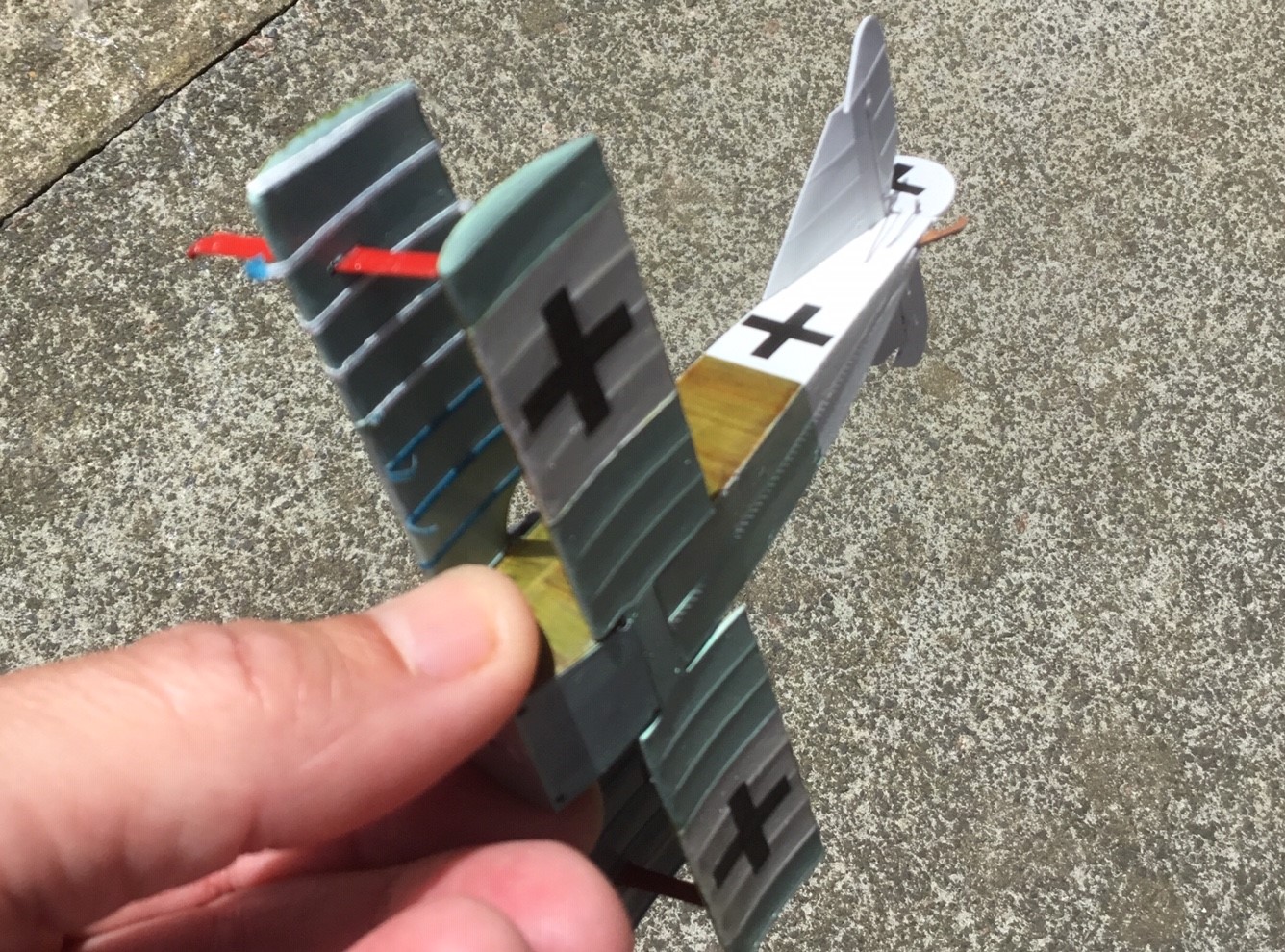
..time for a red Triplane. What collection of aeroplane models worthy of the name could possibly fail to feature Richthofen's Dr.1? This is the Revell re-box of the Eduard kit - and I'm still having trouble aligning the wings. For some reason the middle wing is slightly askew. 


Richthofen's all-red Dr. 1 was 425/17 - and this was the machine in which the 'Rittmeister' met his end. However Revell supply the old style crosses which is not accurate for the Red Baron's last flight.


Spot the 'deliberate' mistake - I've put the 'Axial' stickers on a non-Axial prop. Will have to fix that. Finishing was not as straight-forward as it might have seemed. Firstly what 'red' to use? and, secondly, how to 'weather' it? In the end I elected to go with  Humbrol 'crimson red' (132) brush-painted in very thin layers and to 'tone' it down a little I tried the oil dot filter method..


Photographed on Leon Bennett's "Three wings for the Red Baron" (Helion, 2019) - a treatise on early aeronautical science and the cul-de-sac that was the triplane. The book examines why exactly Richthofen was such an enthusiastic advocate for a machine in which both himself and other leading German aces lost their lives. Spoiler alert - it even appears that his 'admiration' for the Sopwith Triplane was based on no more than hearsay...and if Leon should happen to chance on this page can I just point out to him that 'la vache' has another meaning in French...


See my other Eduard Triplane build on this blog here

Sunday, 9 March 2025

Boater Bill's colourful collection of WWI machines - Eduard Dr.1 in 72nd


Yellow: Lothar von Richtofen, Jasta 11
Black: Josef Jacobs, Jasta 7
White: Hans Weiss, Jasta 11
Blue: Wilhelm Schwartz, Jasta 13
Lilac: Rudolf Stark, Jasta 34b
Green: Friedrich Kempf, Jasta 2 Boelcke
Red/white: August Raben, Jasta 18

Bill's best tips for building the Eduard Dr.1 in 72nd

" Some things I learned the hard way:

- The wing struts have a top and bottom. If you put them in upside down, they fit OK on the bottom wing, but the top wing’s angle of attack will be way off (trailing edge way too low) and the cabanes won’t fit.

- Make sure the wing struts are parallel when installed when viewed from the side. There’s a little bit of wiggle room in the middle wing’s slot- any misalignment will be magnified by a top wing that is skewed, with a leading edge that is not parallel to the other two.

- It is easy to put the stab on upside down (twice!). It is too easy to overlook the little dimples that are for the strut braces on the bottom - that is the only difference between top and bottom. (No key or tab to align the stab with the opening in the fuselage.)

- Pay close attention to part numbers for the landing gear struts- it is very easy to mix them up. I learned to not remove the second one from the sprue until I had glued the first one in place, on the correct side. Ditto for the cabanes.

- I found it best to install the cabanes on the top wing first, let them set for a bit, then attach the wing to the model.

- The stab braces are very flimsy- I broke about half of them while trying to clean up the sprue attachment. A similarly sized piece of Evergreen styrene is less brittle, and easier to handle.

- The guns won’t fit properly unless you sand the fuselage opening part to make it a little wider.

- If you are adding a pilot (I used the nice PJ Productions resin figures) don't bother to install the seat.

Bill's WWI slideshow is here


Recent addition to Bill's collection from the Revell kit a JG III Dr.1   - all markings painted and masked. Intending to do some of Loerzer's machines so posted here..


Thursday, 12 January 2023

first completion of 2023 - another Eduard Bf 109 G-6 Heinz Bartels 11./JG 27


now that the house-move and the latest book project are out of the way I can get back to building some models. If only the airbrush would work 'properly'..


Here's my first completion of 2023, another of the 'old' new-tool Eduard Bf 109s, this time in the markings of 11./JG 27 ace Bartels. IV./JG 27 were at Kalamaki, Greece in the autumn of 1943 and intervened over Kos and Leros during October as German forces pushed out the British from these Dodecanese islands following the Italian 'change-of-sides'..

A couple of the images of the finished model show the 72nd Academy G-6 in the 'same' scheme as well, although as Gary Hatcher put it, how can Luftwaffe modellers be satisfied knowing that their mottling is always so 'hit and miss'? I mean all of the known images of this machine show the port side - not one shows the starboard side AFAIK. Upper surface 'saw-tooth' finish was a feature of some Erla 1943 production, re-created here easily enough with a P-Mask mask. The underwing 'R6' MG 151 cannon gondola have been opened up to display the Eduard resin cannon..


Sunday, 3 November 2019

Three months since my last post ..so what's been going on ?


To paraphrase "Scale model soup " - blimey, I can’t believe it’s been more than three months since my last post! Time sure flies, especially as you get older. Suffice to say, I’m still here. So what’s been going on? On the basis that you might be vaguely interested....here goes..

 Since my last post here..I've written two books ! And a publisher is interested! Here's a mock up of the cover of the first one - doesn't take a great deal of effort to work out what the second title might be either. Of course these titles weren't compiled overnight - they are the synthesis of about ten years work on various projects..


Ok so you're thinking same old, same old..but both titles are jam-packed with great photos from a number of Luftwaffe alumini and artworks by Vincent Dhorne. And no-where do I say that Hartmann was credited with 352 kills or that Walther Dahl managed 128 victories including 36 heavy bombers...

In the same series I collaborated with Jean-Louis Roba on this next title earlier in the year and it is now available from the usual sources!


Features first person accounts, artworks, 200 photos, nice thick glossy paper and glossy card cover.

Elsewhere Eduard's new Bf 109 G-6/AS is released - one of the five markings options is for F-K Müller's 'red 2', the 1./NJGr 10 Moskito hunter flown by the ace during July-August 1944. I'd already written about this machine on my Luftwaffe blog and was invited to submit a lengthier appraisal for the latest Eduard INFO.

My 'history' feature on Müller's aircraft and night fighter career complete with rare photos and first person accounts is available to read in the free 76-page November issue of Eduard Info - download it here


...now to get some modelling done..


Wednesday, 26 June 2019

Eduard Fokker Dr.1 48th - build review finished


Official Kogenluft photo taken at Léchelle, France in late March/Early April 1918 records at least 13 Triplanes of Jastas 6 and 11 (JG I) at the height of the great Offensive. Alex Imrie stated, "During the advance which resulted from the Spring Offensive, JG I occupied the British aerodrome at Léchelle on the evening of 26 March. This photo of Jasta 6 Triplanes lined up there was probably taken a few days later, and shows the aircraft undergoing national insignia changes." There are both Iron Cross (Eisernes Kreuz) and Balkenkreuz markings on view in this image but all the rudders featuring the newly-applied Balkenkreuz are white. Just beyond the fellow with the binoculars, beyond a two-seater DFW C.V hack machine marked with the number '3', can be seen the red-painted top wing of Richthofen's 425/17 partially obscured by another Triplane - in front of the last of the Bessoneau hangars. The Dr. 1 of Jasta 11 ace Hans Weiss Dr. 1 (545/17) is somewhere on this image...Click to view large..


Completed in the markings of Jasta 11 ace Hans Weiss Dr. 1 545/17 (WNr. 2213 seen on lower rudder). As the name implies much of his machine was painted white.


The Eduard Dr. 1 kit is nicely detailed and I used some of the etch from the ProfiPACK box in the stash to enhance the cockpit (compass etc). The plastic control yoke in the kit is nicely done- on the etch sheet you will find some tiny 'L' and 'R' placards for the MGs ( 'left' and 'right' in German is 'links' and 'rechts'). The fuel tank air pressure hand pump for the right side of the cockpit was scratched..The back of the aluminum seat was evidently covered in fabric on the inner face and the seat cushion was the parachute pack. The alu ammunition boxes don't sit very well in the forward fuselage and needed trimming. Everything lines up well though with the Spandaus which really need the etch jackets of course. Eduard's etch includes the Bowden cable arrangement that operated the triggers on the real machine. The fuel gauge on the upper deck cowling has an etch dial face. As noted previously, aligning the wings proved problematic - on my next build I will do more to ensure that the lower wing sits 'square' in the lower fuselage. The underbelly fuselage seam is fixed with an etch stitching strip and the seam under the forward fuselage can be hidden as I did here with an etch plate which helps secure the very fragile front landing gear legs so there is an even placement of the whole undercarriage - something else I found pretty tricky to achieve. One thing I didn't do on my model was 'fix' the clear inspection window in the top wing which needs to be relocated and the raised edges sanded down. Next time... There are two propeller types offered in the kit - Axial and Heine. Painting a 'laminated' propeller is fairly straight forward - I simply gave the item a coat of “buff” or linen and when dry, streaked some burnt umber oil over the part with a stiff brush. You could mask the prop off in strips. I used a similar technique for the wings with '502 Abteilung' Olive green oil paint. Eduard's etch sheet for the Dr.1 includes the "Reich” / government ownership plate located on the starboard side of the cowling. I did some minimal rigging with E-Z Line which I always find difficult to work with as it is so 'elastic'.  Thanks to Stephen T. Lawson for help with this build!


 The first victory recorded in a Fokker Triplane was achieved by Rittmeister Manfred von Richthofen when he brought down an RE 8 on the morning of 1 September 1917 for his 60th victory in his first combat flight in the type. (Kranzhof states 2 September). The crew believed the oncoming machine to be a British Sopwith Triplane. Poor construction and the proximity of the top wing to the propeller wash subsequently caused a number of well-documented failures in-flight. The type was temporarily withdrawn to re-appear in strength in January 1918. The Fokker Triplane equipped most of the Jagdstaffeln of the three Jagdgeschwader of the German Fliegertruppe during the first half of 1918.


Incidentally, the word Jagdgeschwader translates as 'fighter wing' or 'fighter wings' - there is NO plural form of this word in German, unless the sentence construction in the German involves a dative case. There is no 's' and certainly no 'n' at the end of the word in its nominative form! One of my pet 'hates' when reading works by authors who don't really know German - even vanWyngarden does this, although in every other respect I find his work to be exceptional. Shame that Osprey have stated that it doesn't sell well and that apparently there will be no more..


Monday, 24 June 2019

Eduard Fokker Dr.1 48th - build review (2)


Putting the wings on the Fokker - I haven't seen many builds of the Eduard Dr. 1 - apart from perhaps Stephen T. Lawson's on aeroscale - but those that do exist all state that the kit assembles well. I found the struts a little difficult to fit through the centre wing, managing to snap one completely. Superglue has definitely been my friend on this build. Both cabane struts broke as well needless to say and fixing those was tricky, but the top wing was eventually attached securely without too much damage.

Just visible in the lower pic is the delicate molding of the distinctive saw-tooth ply covering over the upper surfaces of the wing leading edge


Friday, 14 June 2019

Eduard Fokker Dr. 1 48 scale - build review part I


Fokker's Dreidekker (Dr.) 1 is another of those hopelessly over-rated German technological achievements, the Triplane being arguably one of the biggest aeronautical developmental cul-de-sacs in the history of flight. Promoted by no less an airman than the Rittmeister von Richthofen himself - a cold-blooded 'killer' who actually took little pleasure in flying and who forbade his pilots from any sort of 'stunting' - the type had the briefest of combat careers during the first half of 1918 and acquired a notoriety way beyond its limited capabilities. Quite simply three wings were terribly inefficient, the engine technology available to Fokker was unreliable, build quality and control in his factory was negligent and the type was soon out-performed in most areas by comparable Allied types. The Dr.1 was quickly superseded by Fokker's own D.VII but not before a number of German 'celebrity' aces had lost their lives in the type - either brought down at the hands of Allied aces, killed by 'fluke' rounds from supposed 'ground fire' or crashing as a result of defective workmanship.. Fokker of course was a Dutch national who made a lot of money from the German war effort during 1914-18. In Kranzhoff's excellent book on the Dr. I in the Motorbuch Verlag series "Flugzeuge die Geschichte machten" ('Aircraft that made history') you can read how he misappropriated the interrupter gear technology from a 1914 German patent - there was a court case - and then jealously guarded the monopoly of this technology from other German manufacturers, quickly making his first million. Dubbed the 'flying machine gun'  ('das fliegendes Maschinengewehr') the Dr. 1 was no 'miracle weapon' and was built in only modest numbers. Notable Dr. 1 pilots -aside from Voss, Richthofen etc - did however go on to assume leading roles in the post-1933 Luftwaffe including of course Göring (Reichsluftfahrtminister), Udet (Generalluftzeugmeister), Bodenschatz and Blume.  Dr. 1 pilot and Jasta 34 CO Robert Ritter von Greim eventually became Göring's successor at the head of the Luftwaffe, while Fokker's Waffenspezialist Heinrich Lübbe went on to found Arado appointing former Dr. 1 pilot von Schoenebeck as Chefpilot...

Having said all that I quite like triplanes and would love to have a colourful line-up on the shelf.  A modelling cliché - or so I read on a forum recently - but a nicely done display of Richthofen's machines might look quite impressive I reckon. Of course I failed to take into account the amount of colour 'research' required. Think WW II Luftwaffe colours is a bit of a minefield? Try reading up on triplane colours! Happily Greg vanWyngarden has published a certain amount of reliable material for Osprey which is easily available - although WW I stuff doesn't sell too well apparently.

Recently I started an Eduard 'weekend edition' of their nice 48th scale Dr. I kit and also opened the Revell boxing of the same plastic. Four or five weekends later I'm still hard at work on the kit(s). My incompetence, no fault of Eduard's I hasten to add.


Parts primed and experimenting with the streaky Fokker finish using oil paints. A certain amount of painting and decaling can be carried out before construction starts...below, simulating a rib tape effect with thin strips of tape and a quick squirt of Tamiya smoke..


This is where the build is at currently. The very neat etch Spandaus await installation and, bottom, mounted in the cockpit. The wings are painted for assembly, apertures drilled out to accept some minimal rigging using EZ-line. In the colours of Ltn Hans Weiss 18-victory ace with Jasta 11.


Wednesday, 5 June 2019

Eduard & Revell new issue Fw 190 A-8/R2


Box-art by Piotr Forkasiewicz for the new Eduard 1/48 scale ProfiPACK Edition kit of German fighter aircraft Focke-Wulf Fw 190 A-8/R2 (cat. no. 82145) released June 2019. Markings research by this blog for Eduard. Hans Weik's machine pictured on the 18 July 1944 Memmingen airfield raid..


New issue 32nd scale Sturmbock A-8/R2 from Revell. Unbeatable value for the money. Markings research assistance to Andreas Klein for Revell provided by this blog.