Showing posts with label WW I aviation. Show all posts

Saturday, 20 June 2026

Great War SIG at West Norfolk IPMS show


.. first post taking in the SIGs at last week's IPMS West Norfolk show. These fine 1:72 models are all the work of Mr Steve Cox. Although there were no triplanes on the table until I pointed it out. Note that Steve doesn't rig his builds - his 'philosophy' is that building model kits should be 'for fun' and rigging is not fun! Note that some of these 72nd scale models like the Friedrichshafen and Gotha bombers are vac-forms!  That doesn't sound like fun either to be honest!


Wednesday, 12 March 2025

..another Revell/Eduard Dr.1 - Richthofen's last machine 425/17 "Three wings for the Red Baron"


..time for a red Triplane. What collection of aeroplane models worthy of the name could possibly fail to feature Richthofen's Dr.1? This is the Revell re-box of the Eduard kit - and I'm still having trouble aligning the wings. For some reason the middle wing is slightly askew. 


Richthofen's all-red Dr. 1 was 425/17 - and this was the machine in which the 'Rittmeister' met his end. However Revell supply the old style crosses which is not accurate for the Red Baron's last flight.


Spot the 'deliberate' mistake - I've put the 'Axial' stickers on a non-Axial prop. Will have to fix that. Finishing was not as straight-forward as it might have seemed. Firstly what 'red' to use? and, secondly, how to 'weather' it? In the end I elected to go with  Humbrol 'crimson red' (132) brush-painted in very thin layers and to 'tone' it down a little I tried the oil dot filter method..


Photographed on Leon Bennett's "Three wings for the Red Baron" (Helion, 2019) - a treatise on early aeronautical science and the cul-de-sac that was the triplane. The book examines why exactly Richthofen was such an enthusiastic advocate for a machine in which both himself and other leading German aces lost their lives. Spoiler alert - it even appears that his 'admiration' for the Sopwith Triplane was based on no more than hearsay...and if Leon should happen to chance on this page can I just point out to him that 'la vache' has another meaning in French...


See my other Eduard Triplane build on this blog here

Sunday, 9 March 2025

Boater Bill's colourful collection of WWI machines - Eduard Dr.1 in 72nd


Yellow: Lothar von Richtofen, Jasta 11
Black: Josef Jacobs, Jasta 7
White: Hans Weiss, Jasta 11
Blue: Wilhelm Schwartz, Jasta 13
Lilac: Rudolf Stark, Jasta 34b
Green: Friedrich Kempf, Jasta 2 Boelcke
Red/white: August Raben, Jasta 18

Bill's best tips for building the Eduard Dr.1 in 72nd

" Some things I learned the hard way:

- The wing struts have a top and bottom. If you put them in upside down, they fit OK on the bottom wing, but the top wing’s angle of attack will be way off (trailing edge way too low) and the cabanes won’t fit.

- Make sure the wing struts are parallel when installed when viewed from the side. There’s a little bit of wiggle room in the middle wing’s slot- any misalignment will be magnified by a top wing that is skewed, with a leading edge that is not parallel to the other two.

- It is easy to put the stab on upside down (twice!). It is too easy to overlook the little dimples that are for the strut braces on the bottom - that is the only difference between top and bottom. (No key or tab to align the stab with the opening in the fuselage.)

- Pay close attention to part numbers for the landing gear struts- it is very easy to mix them up. I learned to not remove the second one from the sprue until I had glued the first one in place, on the correct side. Ditto for the cabanes.

- I found it best to install the cabanes on the top wing first, let them set for a bit, then attach the wing to the model.

- The stab braces are very flimsy- I broke about half of them while trying to clean up the sprue attachment. A similarly sized piece of Evergreen styrene is less brittle, and easier to handle.

- The guns won’t fit properly unless you sand the fuselage opening part to make it a little wider.

- If you are adding a pilot (I used the nice PJ Productions resin figures) don't bother to install the seat.

Bill's WWI slideshow is here


Recent addition to Bill's collection from the Revell kit a JG III Dr.1   - all markings painted and masked. Intending to do some of Loerzer's machines so posted here..


Friday, 14 February 2025

Fokker E.V/D.VIII - Roden 1:72nd


First completed build of 2025 - a Roden 1/72 Fokker D. VIII. Not an easy kit due to the multiple small struts (12), shallow locating points and horrible lozenge camo decals, which either disintegrate when coming off the backing paper or dissolve if cement goes anywhere near them ..or both. I gather this is par for the course with early Roden stuff. ..kit no. 004!. I did manage to get them on after a fashion but had to do lots of touching-up. The 'tulip petals' on the cowl were simply cobbled together from scrap decals, mostly German crosses as it happens with nicely angled pieces of black and white decal. Really this should have ended up in the bin on a number of occasions ..but I persevered and in the end was determined that I was going to post some pictures here.


According to the Windsock book on the type, the type had the usual Fokker metal tube frame with canvas stretched over it, except around the engine where it was covered with metal panels. The cockpit area had a varnished plywood floor and sides, with a canvas "rear bulkhead" behind the seat. Apparently the bottom end of the control column actually stuck out of the underside of the fuselage with the control cables attached to it, but Roden do not show that. The build looked tricky enough as it was.

The various locating holes all need drilling out  - some were supposed to take two struts!  But when the lozenge decals have been applied you then need to find and re-open the locating holes for the struts - try doing that without damaging those super-fragile decals. The decals are unfortunately so poor that just about any cement will attack and dissolve them even with a coat of acrylic varnish over them.. 

Best way to attach the wing I found, was to turn everything upside down, having cemented the struts into the fuselage. All struts are separate parts. I did not use any superglue, but applied tube cement and waited a bit for it to go tacky before positioning everything.

In 1918 the German authorities changed the way they ordered aircraft and in January (or perhaps February according to some sources) the first of a series of competitive trials took place at the Adlershof airfield at Johannisthal near Berlin. Around 27 aircraft were submitted for testing from 10 manufacturers, the Fokker V11 prototype was chosen and entered service as the D.VII ( though small orders were also placed for the Fokker D.VI). In May/June a second competition was held with perhaps 37 planes from 12 manufacturers, though I should perhaps point out that quite a few were either slightly modified existing types, or the same type with different engines. Of the 10 or so aircraft entered by Fokker, the parasol winged V.26 powered by a 110hp Oberursel engine was adjudged the winner due to a combination of speed, climb and handling, and orders were placed for 100 as the Fokker E.V, followed by a later order for a further 200. Orders were incidentally also placed for the Pfalz D.XII, perhaps as a back up. Deliveries started in late July and Jasta 6 of the Richtofen Geschwader received their first planes by August 5th, but then on August 16th and 19th two of their planes crashed due to wing failure and production was halted pending investigation. Fokker claimed the problem lay with the official insistence on using a strengthened rear spar which was breaking rather than flexing under load, but the enquiry thought that, as with the earlier Dr.I it was actually down to a combination of shoddy manufacture and sub-standard components. Fokker was lucky not to end up in jail, but after agreeing to recall all the E.V and fit them with a redesigned wing he was allowed to start again on September 24th 1918, by which time it had been decided to use a "D" designation for all fighters so it became the D.VIII. It is unclear exactly how many D.VIII were produced, and indeed how many were actually E.V with the new wing. Sources vary and I have seen the figure of 381 quoted, but the Windsock book lists a total of 289 accepted by the air force. though post war pictures of the factory show lots of D.VIII lying around, and it is thought that maybe only between 60 and 80 actually reached front line squadrons. (text by Peter Booth) 


 After the war a few entered service with the Dutch and Polish air forces whilst others were flown by the US Army Air Corps and for civilian use in Italy. The kit comes with 4 options - one Japanese, one Polish and two German. The box art shows Loewenhardt's machine, supposedly of Jasta 11 but the markings (black and white striped tailplane) are typical of Jasta 6.

I'm getting a bit of a taste for these tiny Roden kits - the sense of accomplishment when/if you manage to complete the kit is certainly enhanced compared to the usual single-seat fighter build and the finished model (smaller than some of Callum's 1:144 stuff) certainly received some nice comments when put on the table at our February model club night which was nice!


Wednesday, 10 April 2024

East Kent Scale modellers club night 09 April - an impromptu 899 NAS line-up


After missing a couple of meetings thanks to other stuff it was nice to get up to RAF Manston and the history museum cafe/canteen for the monthly club meet of East Kent Scale modellers. As usual some fantastic models on display and plenty of model 'chat' and  'advice' and tips being dispensed ..

Dave's Skyhawk and Mitsubishi T-2


Callum's GwH 1:144 TSR 2


Dick's Airfix Sea Vixen in a line-up  of 899 Sqd machines...


Two of Rod's WnW masterpieces, a DH 2 and a naval Camel..


Peter's HPH 32nd scale SG 38 glider (partially built) and Dick's Special Hobby DFS 230 


Robert's Italeri 72nd Ju 188. Re-scribed panel lines and a neat finish..


Dick's Arma Hobby Hurricane. Lovely kit, decals apparently "a pain.."


The end of the 899 NAS line-up featured Bill's Hunter T8M. XL603 was one of two Hunter T8M conversions operated by 899 Squadron as radar trainers, fitted with the Blue Fox radar..


this is Henry's 32nd Hasegawa Raiden ('Jack')


Harrier trainers from the Kinetic kit by Dick and Bill..


Stu's Airfix Meteor in 72nd. Lots of great comments on his super metallic finish - Tamiya


Wednesday, 4 October 2023

Roden Fokker Dr. 1 72nd Jasta 12 Fw. Ulrich Neckel

You often hear people say, if you want to do something from WW I with not much rigging, try building a Fokker Dr. 1 triplane model. You have to wonder whether those people have actually done that - because building triplanes - especially in 72nd scale - is not easy even without having to worry too much about rigging!


The Roden kit is nice enough - quite detailed including separate sets of ailerons but very fiddly with its minuscule parts, including the internal cockpit framework and all the struts as separate parts, none of which have decent locating holes. I notice that sites such as Scott's 'Modelling Madness' have only ever done an in-box review of this kit. Which is pretty useless really - its not until you get into the build that you realise that some things are awry; eg the decals which are slightly over-sized and don't fit! Not to mention disintegrate on being moved from the backing paper. Fortunately there were two sets in my box - and one appeared to have been reprinted to the right dimensions (?). 


Fantastic box-art by the way. And lots of choices on the large decal sheet. Mine is finished in the markings of Fw. Ulrich Neckel of Jasta 12 with typical black rear fuselage and tailplane and 'dirty' white cowl and standard streaked finish over the rest of the airframe. Neckel was born 1898 and was one of the last winners of the Pour Le Mérite, awarded in his case in November 1918 for around 29 victories. He died in 1928 from TB.

To the right is the Revell 72nd Dr 1, probably an 'easier' buld although a little short on detail options. Check out the label links below for more triplanes on this blog..


Also on this blog;

Lt Paul Bäumer's Jasta Boelcke Fokker Dr. 1 204/17 (SMER 1:44th)

Monday, 17 April 2023

Welling Model show and 'open day', Saturday April 15 2023


Welling in south-east London, England, in the borough of Bexley, 'used' to be in the historical county of Kent but is now just part of the huge suburban city sprawl....but it does have a model club and an annual show and 'open day' which a few members of our club attended on Saturday. We headed there on Saturday morning, just 60 miles up the motorway from Canterbury. By 10:00 we had our tables set up and we managed quite a respectable display. I was even tempted to put a few entries into the competition which was a bit of a 'first' for me. There wasn't really much point going up against a scratch-built BE 2a in 32nd scale or Rod Janes' Bristol F2b 'Crocodile' (eventual 'Gold' winner) or even his Junkers D.1 ('Bronze' winner), but still, the point was to support the club. Shame the competition categories were not 'broken down' into scales - Rod might not have won the 72nd scale class after all. In total there were only 67 competition entries, well down on the last 'pre-Covid' show's 200+.  And Medway/East Kent club member Callum's was the only entry in the 'Junior' category. A special shout-out to the bust and figure models from the Faversham club. A few pictures from the event follow.

Your blog host behind our East Kent Modellers table display.


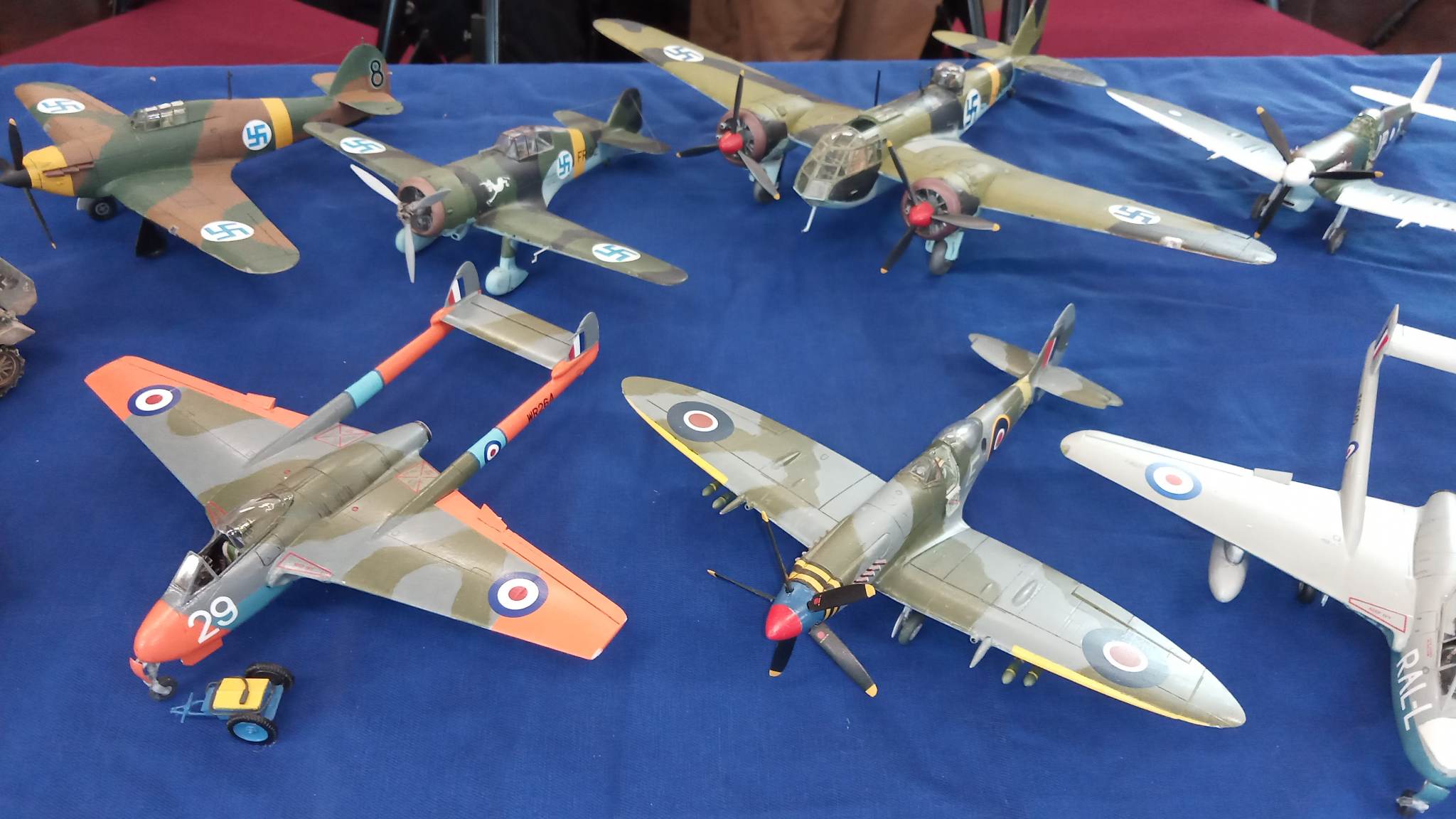
 A selection of club colleague Bob's builds including a couple of superlative Airfix 48th Vampires and an Airfix Blenheim I in Finnish markings. Below these, his T-62 from Tamiya..


 Brush-painted Meng Fokker Dr.1 in 24th scale by David from the Gravesham club. A previous 'Gold' winner at the show..


Rod Janes' WnW  Junkers D.1 (above) and David's brush-painted Eduard D.V in 72nd


A couple of Andy's  Luftwaffe 32nd scale masterpieces


Cast of 'Dad's Army' in bust form by the Faversham club.


'Aircraft' class in the competition. 'Gold' winner was the WnW Bristol F2b and probably the reason why there were so few entries! The checkered masked and painted 'Brisfit' was Rod's 'covid lock-down' project! CSM Caudron was another of Rod's superlative builds...