Showing posts with label RAF P-51 Mustang. Show all posts

Friday, 26 July 2019

48th scale Merlin-engined P-51 Mustangs


The count down to the US Nationals and the release of the 'kit of the year 2019' is on. I'm referring of course to the Eduard P-51. So how many are you looking to add to the stash? If any ? Surely any modeller worth his salt already has a large number of P-51s to build?  Here's a look at some of the 48th scale Mustangs in my stash.


The most recent is the new-tool Airfix P-51D and it certainly appears to build up into a fine model. Here's my friend Bob's build (East Kent Scale modellers)


The P-51 B/C kits by Accurate Miniatures, Tamiya, and Pro-Modeler (Monogram/Revell) are apparently very similar, although the Pro-Modeler one is the most accurate out of the box according to Detail and Scale Mustang vol.1, which covers Mustang variants from prototype to P-51 C. Nowadays, this is probably also the hardest one to find. Of course the Tamiya is reputed to have the best fit of all the kits - indeed it's probably one of the best fitting kits ever. For the P-51 D, the Tamiya and Hasegawa kits are also supposed to be very comparable.

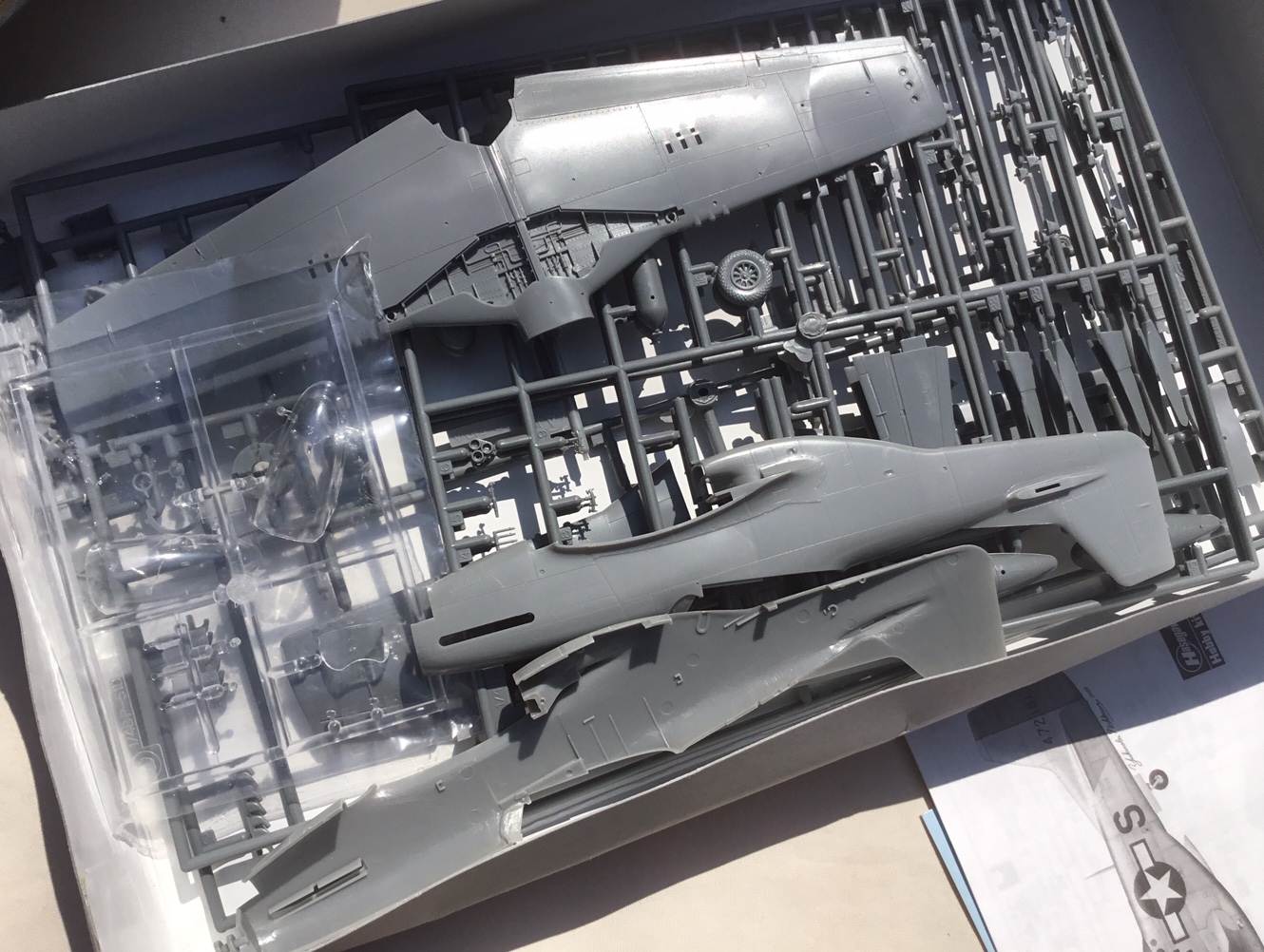


Above; the Hasegawa 'D' looks great in the box with a super level of detail in the cockpit and in the selection of underwing stores. The Tamiya kit has one major advantage over the Hasegawa kit - the separate flaps, which are usually seen 'dropped' on shut-down. Their B/C kit also has separate flaps, unlike the Pro-Modeler and AM kits. However the cockpit floor of the Tamiya P-51 B is probably inaccurate, all Merlin engined P-51's had a flat plywood floor, not metal as in the Tamiya kit.The ICM versions look as good as the Tamiya kits that they may have been 'developed' from, with perhaps not quite such a good fit of parts.

Below; Patrick Chung's beautiful Tamiya 'B'


As I guess is well-known, all the kits of the P-51B/C/D/K in 1/48 scale have their wheel wells boxed in, whereas Merlin-engined P-51s featured no well as such -  the wing spar running straight through the wing essentially comprised the well, so in this regard all 48th scale kits are incorrect, but to be honest this is not the sort of thing that worries me as modeller. Although I do have a resin Aires 'bay' in the stash (below) The Hasegawa P-51D/K has very shallow wheel wells (this can be hidden by modelling the aircraft with the undercarriage doors closed).


Also in the pic above; a long out-of-print Jaguar P-51 B detail set, Ultracast propeller and spinner, Aires corrected undercarriage bay and Ultracast corrected flaps and wheels..

Although it is often said that the Tamiya P-51D is an easy build, the assembly of the canopy can be tricky consisting of a frame to which the glazing is attached. I use either a spare Hasegawa canopy or a Squadron vac form canopy (the Hasegawa canopy is slightly wide when compared to the Tamiya fuselage).

Although the flaps and inner wheel well doors fell as the hydraulic system lost pressure I would not get too hung up (excuse the pun) as your model could represent the aircraft just after shut down.  It is easy to find photo's of Merlin P-51's with the wheel well doors just cracked open and the flaps up.

Bearing in mind that I don't have the Fujimi, Meng or Academy or even the Accurate Miniatures kits, my recommendations for an OOB build would probably be the new Airfix tool - I'm starting one of mine as soon as - and the Hasegawa P-51 D. The Hasegawa D contains more under wing stores than the Tamiya kit and appears - in my opinion- to feature better detail.


Below;

".. when Revell re released the old ICM kit (we all know that this is rather similar to other 1/48th P-51 B kits!) with the markings for AK-A I just had to buy it and here it is.."

Tony O'Toole


Monday, 5 October 2015

first look in the box new-tool KP Mustang P-51 B/C and early P-51s in 1:72nd scale and the trouble with wing kinks


First look at the new-tool KP P-51 B/C Mustang in the box.


As a general rule most 72nd scale early P-51s are pretty inaccurate and a bit of a minefield. The Hasagawa kit - although probably the best looking model in this scale - had a number of errors; a cowling that flattened out over the exhausts, a P-51 D wing and a very shallow wheel well. Academy, although beautifully moulded, features an overly long windscreen which makes the canopy a little short along with the shallow style wheel well. Revell P-51 B/Cs apparently look good overall but the kit is let down by a very narrow seat and very poorly moulded clear parts and again a shallow wheel well. I am told that both the Academy and Revell wings are still not correct for a P-51 B/C. I haven't actually built the Revell kit yet but here is my Academy B/C (alongside the new-tool Airfix D in 72nd). I have a few of these in the stash and aside from the canopy which doesn't appear to fit too well, they are a decent kit..


The biggest problem on most 72nd scale P-51 B-Cs is the wing 'kink' but after comparing with the drawing below, the new KP kit looks to have this reproduced this area well. The problem on other kits seems to occur because the 'kink' on the P-51 D starts both further forward on the fuselage and further outboard on the wing than the earlier versions. Hasegawa put the start of the l/e kink at the right place on the wing, but too far forward (P-51 D place) on the fuselage; Revell did exactly the opposite, getting the fuselage location correct, but using the -51D wing starting point. Academy got the kink shape right, but by basically copying the Hasegawa kit fuselage, made the wing too broad.

drawing below by Martin 'Occa'

more from the KP kit - the 112 Sqd 'sharkmouth' option looks great...


Thursday, 15 November 2012

Polish Mustangs (303 Squadron, AJ Press)


Airfix P-51 in 1:72nd scale finished with Freightdog resin parts as Mustang IVA of No. 303 Squadron. Finished in the markings of CO S/Ldr Witold Lokuciewski. Note scoreboard of 11 black crosses under the windscreen. Decals and inspiration from the superlative AJ Press 'Polish Mustang units' book in their 'Fighting Units in Color' series. Roundels and flashes and Aeroproducts prop decals from the Xtradecal Mustang Mk IV sheet. (to be added)


Super package - A4 decal sheet, colour profiles and full page photos, perfect for the modeller ..and only £12. The decals were a little tricky to apply though, being incredibly thin. Made a mess of two of them. No colour pictures in the book although I did discover a nice colour(-ised?) view of  Jakub Bargielowski's 303 Sq. PD-Y in Militaria XX magazine from Kagero. Below that, a view of the Freightdog resin louvred intakes. I've still not achieved a particularly good fit on these.


Monday, 15 October 2012

Airfix North American P-51 Mustang Mk.IV Gift set - GA-S 112 Sqd - second finish of the month!


 Just finished this one which is good as I've managed to snap the nozzle in my airbrush when trying to extract it for cleaning - won't do that again in a hurry! As before, the weak point of this brilliant little kit is the sliding canopy hood as a two part assembly comprising of a `solid’ plastic framework and a clear glazing bubble. Same applies to the windscreen - because of this extreme care must be taken when removing the clear parts from the sprue as any mistakes cannot be hidden later and the joint between the parts is very toy like. 


 After two coats of Dark Green disruptive camouflage the model had a couple of coats Klear applied ready to receive the decals. Unfortunately the decals provided by Airfix for GA-S have a few errors. The roundels for the fuselage and lower wings are good and were used, along with the sharks mouth and fin stripes. The kit decals include red and blue B Type roundels for the upper wing surfaces which should in fact be the late war C Type with the narrow white ring - these were sourced from the Italeri P-51 kit. The code letters for GA-S appear to be white which is correct, but the serial number KH774 is missing from the sheet altogether. Also missing is the small crocodile insignia which was applied to the left fin area of Mustangs painted by 159 MU, but this could be sourced from the decal sheet of the old Airfix Mustang kit. Note the so-called 'firewall' paint job on this 112 Sqd Mustang. An oil wash brings out some of the nice panel line detail, especially on the resin louvred intake from Freightdog which can be seen nicely in the view below. Also worth mentioning that Freightdog do corrected decals for this machine as well now, which I should really think about investing in as I have no manufacturers decal on my resin Aeroproducts 'uncuffed' prop....you can click on the images to get in a little closer if you've a mind to..cheers, thanks for looking  and see you soon..


Sunday, 9 September 2012

RAF Mustang IV Airfix Gift set with Freightdog Models update set


Unlike the older previous Airfix Mustang kit, which included optional propeller parts to allow a P-51D or P-51K  kit to be built from the box plus a variety of underwing stores including bombs or drop tanks, the new-tool is rather lacking in this respect since all you get in the box is the Hamilton Standard propeller of the P-51 D version plus one set of drop tanks which lack their distinctive 'seam'. Unfortunately this means that the RAF option (a  P-51 K or Mk IVa) featured in the Gift set boxing does not have the 'uncuffed' Aeroproducts propeller nor the distinctive louvered intakes which were fitted to the side of the engine cowlings on many RAF Mustangs. The aircraft featured on the decal sheet of the gift boxing is the well known KH774 GA-S from 112 Squadron. Fortunately Freightdog models have produced a neat little update set which includes a new prop and lower 'louvered' engine cowl..


Here I've made a start on the kit by cutting away the lower cowl - very straightforward since you simply follow the panel lines and the resin insert drops into place. Note that the kit decal sheet provides no serial while the codes are depicted as grey when they should be white. On the painting instructions the propeller spinner is shown to be black when it should either be the wartime red or the post war colour adopted by the unit which was thought to be light blue.

Thursday, 28 July 2011

ICM P-51A Mustang


The North American A-36 Apache and early model P-51 Mustangs had a slightly different profile from the more familiar P-51D, which hasn't been terribly well captured in existing kits. While most agree that their 'D' is a pretty good representation probably based on the Tamiya 'D', the ICM Allison-engined Mustang has a certain number of shortcomings. Basically it is a mish-mash of a kit. It is boxed as a P-51A, but has the narrow air intake above the nose of a Mk.I or Mk.IA/P-51. The wings have the aerodynamic fairings ahead of the ailerons typical of the P-51B/C - although it should be perfectly possible to do something here with a sanding stick. More importantly and probably impossible to correct is the fuselage profile, Allison-engine P-51s having a shallower profile than the Merlin-engined variants - some 3 ins from canopy top to fuselage bottom on the real thing according to Mustang researchers and specialists on the web.


(Above; a long-time exhibit at the Champlin Fighter Museum, A-36A Apache 42-83731 was based at Duxford during 2002-2003)

Nor does the kit feature locating lugs, holes and pins, and it looks like the fit will be rather 'hit n miss' as the fuselage parts are warped. I've seen this kit described as a " sort of a hybrid between the AM mouldings and Tamiya mouldings, quite odd in fact ".  Perhaps because of the hybrid nature of the kit, you get lots of spares box bits eg. it comes with  props and so on for a P-51B/C, two clear instrument panels, different types of exhausts and other details not used in the P-51 A.

(Below;  A-36 at Duxford - a good view of the slotted retracted airbrake in the wing upper surface and the flattened elongated air scoops, both upper and lower)


Wednesday, 9 June 2010

more Mustangs !

This is not a Luftwaffe modelling blog - just thought I'd make that clear. I build everything and anything...even armour. Here's some more P-51s for now..'Bud' Anderson' 'Old Crow' from the Academy 'B/C' kit in 72nd using the kit decals, although with plenty of white glue and Klear to keep them on, and the Italeri 1/72 P-51 in the colours of Gordon Graham of the 355th FG..


Saturday, 10 April 2010

Ray Littge 352nd FG 'Miss Helen'

The main reason for this blog was simply to create a space where I could post a pic or two of my completed builds - my 'virtual model shelf'. I like to try and portray reasonably accurate representations of 'actual' aircraft in history, and while this might look like a 'Luftwaffe kit blog' I'm hoping to post some of my other builds here. My aviation enthusiasms range widely from French inter-war fighters to Predator drones over Afghanistan. I'm also hoping to post some armour stuff here too. I build kits for the sheer fun of it. No other aim. For example I have no intention of writing an opinionated critique of the new Airfix Sea Harrier or Spitfire IX (both of which look like great kits by the way - I've only built the Spit so far) or even of providing a long discourse on weathering techniques or similar modelling topics. While these subjects do interest me and I am always looking to learn and add a technique to my repertoire, I'll leave the descriptions of how to do that to all the 'experts' out there. So in between kits here's another of my Italeri P-51s in 1/72nd scale.


The famous 'Blue-nosers' -the Bodney-based 352nd FG - had been deployed to forward airfields at Asche and Chievres in Belgium during December 1944. The aircraft represented by my model, 44-72216, was assigned to Captain Raymond H Littge of the 487th FS as his personal aircraft and featured the 'bue nose', the squadron markings of a blue rudder and "HO" codes and the individual code letter " M " which was underlined as this was one of two aircraft with the same code letter. Littge's previous mount 44-11330 'E Pluribus Unum' is thought to have been written off in Belgium, so he named his new aircraft 'Miss Helen' after his girlfriend Helen Fischer, who he went on to marry after the war. Littge was no rookie pilot as evidenced by the kill markings on the canopy frame - he already had 10½ confirmed kills, one of which was a Messerschmitt 262 jet fighter, and four other ground kills gained during strafing runs over German airfields. The exact number of missions flown by Littge in this aircraft is unknown, although he was at the controls of this machine on 17th April 1945.


On this date the 352nd FG were tasked with providing an escort for B17's launching a follow up attack upon the marshalling yards at Dresden in south east Germany.

At 11:15 hrs fifty two P-51s were taking off under the leadership of Col James D Mayden, commander of the 352nd FG. Lead by Lt Col W T Halton, the 487th FS contributed 18 aircraft to this large force. Capt Littge was leading 'Red Flight' flying in Miss Helen.

The 352nd joined the bombers at 20,000ft at 13:05 hrs, flying to the south of Fulda. The formation of bombers came under attack from Me 262s making their usual head-on passes, the P-51's also came under attack and one was left damaged. The Me 262 was more than a match for the P-51 and the Luftwaffe suffered no casualties. When reaching the Filders area, 24 fighters lead by Mayden left the B17's and swooped down to their briefed patrol areas to find enemy airfields. They came across the airfield at Plattling. Large numbers of aircraft were parked on the field including IV./JG 300 with their Me 109s. The first eight P-51s made a low pass to draw the flak, eight others including Littge's 'Red Flight', hit the flak positions, while the rest provided top cover. For half an hour each flight took it in turns to make passes over the airfield after a left-right traffic pattern had been established.

In all 66 aircraft were destroyed in these attacks and a further 24 were badly damaged. Six of the destroyed aircraft were claimed by Littge, four Bf109s and two Me262s. During the initial attack on the AA defenses, Miss HELEN was hit badly with the oil tank holed and almost emptied, the manifold pressure line and two electrical lines were also hit. In all Ray Littge made seven passes at various parked aircraft. For this action, he was awarded the Distinguished Flying Cross.

Although the 352nd were to fly four more missions, it is unknown whether Miss Helen flew on any of these since the aircraft required urgent repairs after the Plattling attacks.

Thanks to JSM