Monday, 24 June 2019

Eduard Fokker Dr.1 48th - build review (2)


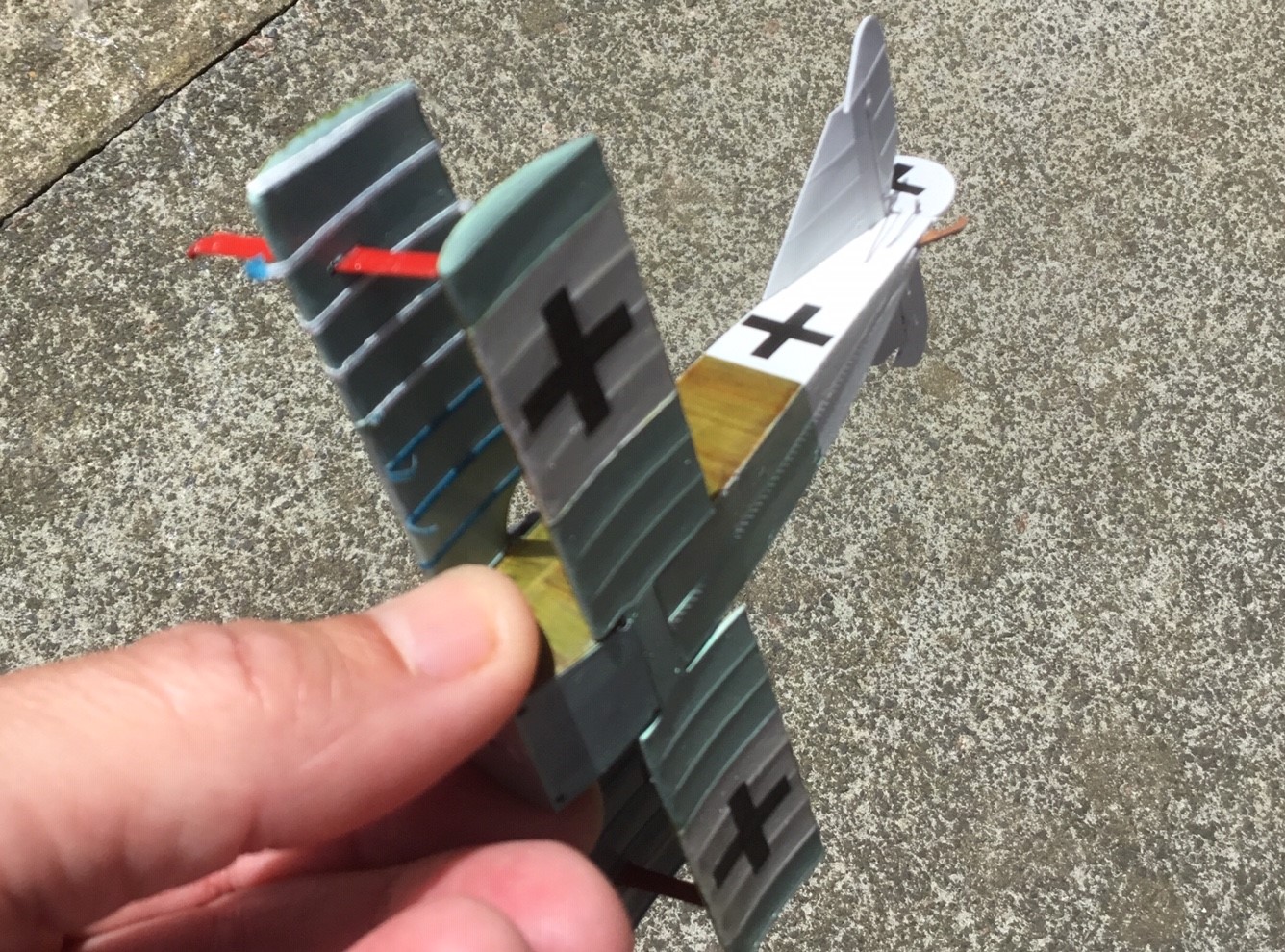
Putting the wings on the Fokker - I haven't seen many builds of the Eduard Dr. 1 - apart from perhaps Stephen T. Lawson's on aeroscale - but those that do exist all state that the kit assembles well. I found the struts a little difficult to fit through the centre wing, managing to snap one completely. Superglue has definitely been my friend on this build. Both cabane struts broke as well needless to say and fixing those was tricky, but the top wing was eventually attached securely without too much damage.

Just visible in the lower pic is the delicate molding of the distinctive saw-tooth ply covering over the upper surfaces of the wing leading edge


Friday, 14 June 2019

Eduard Fokker Dr. 1 48 scale - build review part I


Fokker's Dreidekker (Dr.) 1 is another of those hopelessly over-rated German technological achievements, the Triplane being arguably one of the biggest aeronautical developmental cul-de-sacs in the history of flight. Promoted by no less an airman than the Rittmeister von Richthofen himself - a cold-blooded 'killer' who actually took little pleasure in flying and who forbade his pilots from any sort of 'stunting' - the type had the briefest of combat careers during the first half of 1918 and acquired a notoriety way beyond its limited capabilities. Quite simply three wings were terribly inefficient, the engine technology available to Fokker was unreliable, build quality and control in his factory was negligent and the type was soon out-performed in most areas by comparable Allied types. The Dr.1 was quickly superseded by Fokker's own D.VII but not before a number of German 'celebrity' aces had lost their lives in the type - either brought down at the hands of Allied aces, killed by 'fluke' rounds from supposed 'ground fire' or crashing as a result of defective workmanship.. Fokker of course was a Dutch national who made a lot of money from the German war effort during 1914-18. In Kranzhoff's excellent book on the Dr. I in the Motorbuch Verlag series "Flugzeuge die Geschichte machten" ('Aircraft that made history') you can read how he misappropriated the interrupter gear technology from a 1914 German patent - there was a court case - and then jealously guarded the monopoly of this technology from other German manufacturers, quickly making his first million. Dubbed the 'flying machine gun'  ('das fliegendes Maschinengewehr') the Dr. 1 was no 'miracle weapon' and was built in only modest numbers. Notable Dr. 1 pilots -aside from Voss, Richthofen etc - did however go on to assume leading roles in the post-1933 Luftwaffe including of course Göring (Reichsluftfahrtminister), Udet (Generalluftzeugmeister), Bodenschatz and Blume.  Dr. 1 pilot and Jasta 34 CO Robert Ritter von Greim eventually became Göring's successor at the head of the Luftwaffe, while Fokker's Waffenspezialist Heinrich Lübbe went on to found Arado appointing former Dr. 1 pilot von Schoenebeck as Chefpilot...

Having said all that I quite like triplanes and would love to have a colourful line-up on the shelf.  A modelling cliché - or so I read on a forum recently - but a nicely done display of Richthofen's machines might look quite impressive I reckon. Of course I failed to take into account the amount of colour 'research' required. Think WW II Luftwaffe colours is a bit of a minefield? Try reading up on triplane colours! Happily Greg vanWyngarden has published a certain amount of reliable material for Osprey which is easily available - although WW I stuff doesn't sell too well apparently.

Recently I started an Eduard 'weekend edition' of their nice 48th scale Dr. I kit and also opened the Revell boxing of the same plastic. Four or five weekends later I'm still hard at work on the kit(s). My incompetence, no fault of Eduard's I hasten to add.


Parts primed and experimenting with the streaky Fokker finish using oil paints. A certain amount of painting and decaling can be carried out before construction starts...below, simulating a rib tape effect with thin strips of tape and a quick squirt of Tamiya smoke..


This is where the build is at currently. The very neat etch Spandaus await installation and, bottom, mounted in the cockpit. The wings are painted for assembly, apertures drilled out to accept some minimal rigging using EZ-line. In the colours of Ltn Hans Weiss 18-victory ace with Jasta 11.


Wednesday, 5 June 2019

Eduard & Revell new issue Fw 190 A-8/R2


Box-art by Piotr Forkasiewicz for the new Eduard 1/48 scale ProfiPACK Edition kit of German fighter aircraft Focke-Wulf Fw 190 A-8/R2 (cat. no. 82145) released June 2019. Markings research by this blog for Eduard. Hans Weik's machine pictured on the 18 July 1944 Memmingen airfield raid..


New issue 32nd scale Sturmbock A-8/R2 from Revell. Unbeatable value for the money. Markings research assistance to Andreas Klein for Revell provided by this blog.


Wednesday, 29 May 2019

Eduard´s new 72nd scale Fokker D. VII build by Stefan Schacht

Stefan Schacht has built Eduard´s newly released 72nd scale Fokker D. VII and documented his build with a little 'stop motion' film.

Tuesday, 7 May 2019

Airfix Sea Fury FB. 11 - HMS Glory Korean War scheme, Sea Fury reference walkaround action shots Flying Legends -build review part 3


..painting the new-tool 48th Airfix Sea Fury ..and some stills from archive footage taken on board HMS Glory off Korea. This post is completed with some nice reference'action' shots from a Flying Legends air display back in 2006, especially useful for the oil streaking on the lower surfaces..


This British Pathe newsreel looks to be taken from the same Korean War cruise as per the kit decals HMS Glory Korean War scheme as shown on the box top. A single click to view here. Now the kit instructions have the spinner in black - the more I look at this footage the 'less' black it appears...


Flying Legends 2006 - click on the images to view large..


Saturday, 27 April 2019

Revell corsair F4U-1B 1846 NAS Fleet Air Arm, HMS Colossus, July 1945


Revell's 'Royal Navy' boxing of their 72nd F4U Corsair - 'difficulty level' 4 out of 5 for a 72nd scale fighter?  Well, that would be the nine-part wing and  the five-part cowl I guess. Difficult to get everything lined up neatly but with a bit of care it all goes together well enough. And at least the horrible white plastic of the first release has gone..

Love this machine and it looks great in 'Navy' roundels..and after all the Royal Navy was flying them off carriers first ..


The kit markings are an interesting choice on Revell’s part. They were presumably accurate at one point but despite the Zero falling away in flames on the box art, HMS Colossus never saw combat with the  British Pacific Fleet.. Those standard European theatre markings were on the ships aircraft when she left Glasgow , bound for Ceylon and ultimately Australia. BPF markings were applied either en route or in Australia. By the time Colossus left Australia on her first war cruise, hostilities had ended.

Below; a few views of Corsair KD 431 in the Fleet Air Arm museum, Yeovilton in its original glossy midnight blue albeit very scratched finish..see " Corsair KD 431 - the time capsule fighter " by David Morris for the story of this machine's restoration.


The subject of the Revell kit is KD 344, one of the final batch of 857 Goodyear built Corsairs, called the FG-1 Corsair IV in Fleet Air Arm use. It was delivered to the Fleet Air Arm and was embarked on board HMS Colossus after she completed her sea trials and sailed for Ceylon (Sri Lanka) on 12 March 1945.

 On 8th July 1945 KD 344 is reported as ending up in the barriers with Sub-Lt J.D. Garden RNVR flying when the hook jumped the arrestor wire. The Corsairs and Barracudas were offloaded on 17th January 1946 to Royal Naval Air Station Wingfield near Capetown, they were re-embarked in April. In July of the same year the Colossus was transferred on a 5 year loan to the French Navy as the Arromanches, which later became a permanent transfer.


 Senior Pilot of 1846 Sqn. was Lt. Henry Adlam. His memoir is entitled 'On and Off the Flight Deck'  and it is a fascinating insight into the life of a naval fighter pilot. Adlam takes part in many campaigns including Salerno, Escort carrier flying and the attacks on Palembang as a Hellcat pilot. Later he becomes a batsman and joins 1846 Sqn., based aboard HMS Colossus from 1945-1946. In June 1945 1846 Sqn joined the 14th Carrier Air Group to continue the fight against Japan. The Sqn. went to Australia but the war ended before the carrier and it's air group could take part in any operations. The Sqn. Corsairs were subsequently dumped at sea somewhere near Sydney. After ferrying many serviceman that had been POWs the carrier sailed for South Africa where the aircraft were temporarily based at Wingfield. It is here that many of 1846 Sqn's well known photos were taken.

Monday, 22 April 2019

Airfix Sea Fury FB.11- build review (2)


 Difficult to believe that this build has been on-going for one whole year!

That's one year during which I've done little or nothing...
but with temperatures hitting a record 26C for an Easter weekend here we are out in the garden again ...

Lovely kit, just a couple of 'tricky' seams. The most ‘difficult’ part of this build would appear to be the multi-part cowling; some modellers have had trouble lining up all the parts and a resin replacement at nearly £5 is/was available! I hate to think what the price of the Barracuda resin cowl part might be in £££. Another 'issue' perhaps is the lack of gun sight in the kit. However the Eduard Mk VIII, IX and XVI kits all have two gun sights and these are apparently correct for the Sea Fury. I've now got to the painting stage - apart from making my own shade of that curious 'Hawker primer' colour for gear legs and wheel wells painting should be straight forward but I'm just a little disappointed that you can't do a 'striped' example from the kit directly..


Part 1 of this build on this blog here